Boston Calling …. I live by the river

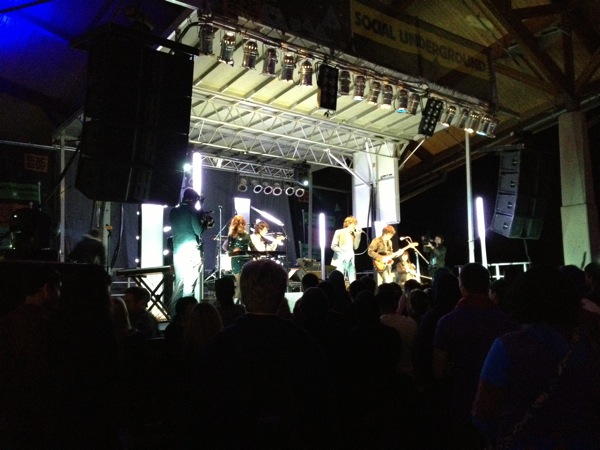
So, this is going to be pretty fun, eh?

It'll fill the void left by the dear departed FNX Best Music Poll, the usual summer festival that (when at its peak) would grab a few headliners to play 45 minute sets on Landsdowne St., and then fill up the clubs on Landsdowne with smaller bands playing 30-45 minutes.

Those were always really, really great shows.

Boston Calling sounds like it's going to be bigger than FNX's shows, but smaller than Lollapalooza or Bonnaroo. Which is cool with me. I don't have it in me to go camp out for a weekend or deal with billions of people. This will be crowded, but hopefully (given its location in City Hall Plaza), somewhat smaller.

None of the sets will be conflicting, which is great for Sunday's lineup, where almost every band is one I'd like to see.

Saturday's lineup is weaker. I'd really like to see Cults and The Shins. I've got some interest in Portugal. The Man, Bad Rabbits (who in my limited exposure sound a bit like The Campaign for Real Time), St. Lucia are all interesting.

(Let's set aside the fact that Fun. is the headliner on Saturday. I may be leaving early.)

Sunday's lineup, though. Whoa. Straight through, every band is one I'd like to see. Dirty Projectors? Andrew Bird? Check and check. Ra Ra Riot? Only downside is that there might be even more sensitive bros than usual.

Come on down to Harmontown

A few weeks back, I started listening to the Harmontown podcast. Now I'm somewhat obssessed. I don't know how to describe it. An often-hilarious, ridiculously filthy, sometimes brilliantly insightful podcast from Dan Harmon (of Community fame) and friends.

You need to go in with no expectations. No matter what you're expecting, it's not that.

The most recent episode has a shower/bath debate that is hilariously insane.

An episode from Salt Lake City has a long discussion on religion.

Listen to it by yourself. You need to figure out whether or not you're ok with other people hearing the show without context.

But, I promise, if you're anything like me, you'll find yourself cracking up (and freaking out the people around you on the train) on a regular basis.

Challenging

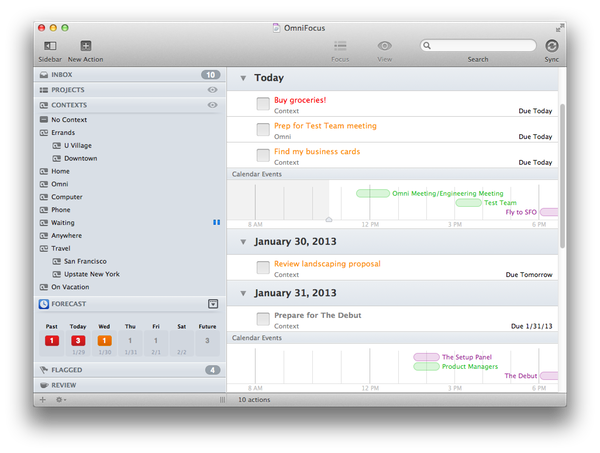
A couple of months ago, I changed roles (part time) in the company. I moved to a team with the premise that a small team of developers, unencumbered by the process and inertia of a large company, could develop and iterate on products and find things that were good fits for our customers. In a big company (which my little company now is), it was a great—maybe ideal— opportunity. A small, (little a) agile team cranking out product.

As of two weeks ago, I'm back in the main office, managing the entire team of developers, while in the midst of the business adopting the (big a) Agile methodology. It's probably been two of the most challenging weeks of my career.

Our development process was never "waterfall", but it wasn't "agile". It was some in between mish-mash of working on what was important and reprioritizing weekly without the understanding that not everything deserved to be worked on. Not everything was important to the business. Loads of horse trading so that everyone got their slice of resources, without regard to how much value those resources might generate for the company.

In that regard, agile (or maybe that's Agile) has definitely helped. We're slowly helping people realize that we don't have infinite resources, and therefore, we can only work on the really important stuff (and maybe some slightly less than really important stuff). But no "because I want it" stuff.

It's not been easy. It's been a slog. As a company, other parts of the business (not the development team) are still getting on board, which is a challenge. There's the culture clash: do you bridge the gap between the old process and new, or push everyone in the deep end. The former means slower adoption, the latter can lead to some interesting conflict.

All this is going on while still needing to ship code and re-learn how to manage a team of people. With some people pushing to move faster than the organization (and team and individuals and processes and technology) might be ready to.

It's going to be an interesting challenge.

Losing Nemo

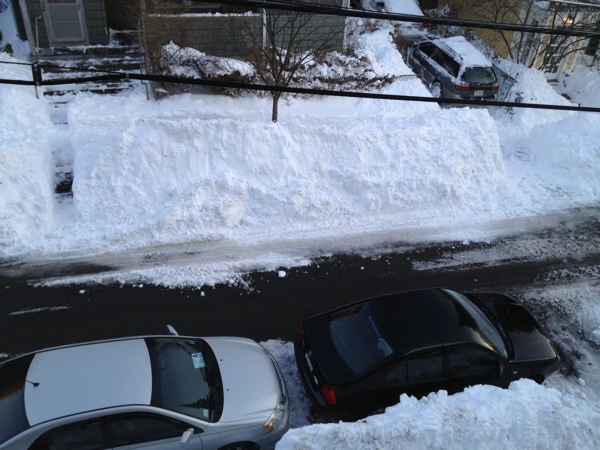
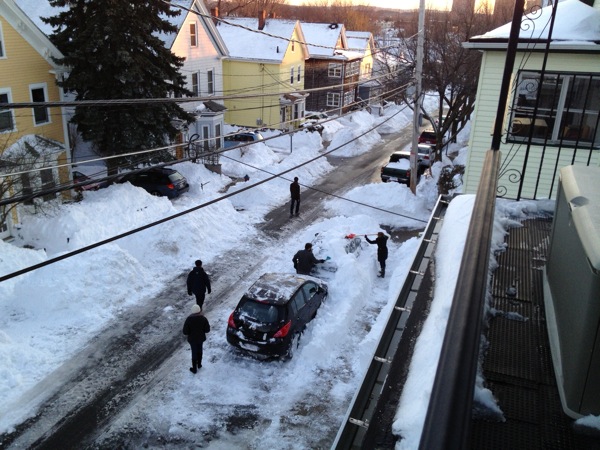
The blizzard/huge winter storm/whatever Nemo, or "the storm that would be named Nemo, but we don't name winter storms" came and went and dumped somewhere between 20 and 30 inches on us here in Somerville.

After spending most of Friday and Saturday snowed in, it dawned on me how poorly we are equipped to handle large snowstorms. I don't mean equipped as humans—it seems like folks mostly heeded the warnings and hunkered down. Or as a society—it seems like a storm like this brings out the best in (most) people, as folks helped each other shovel out, while kids walked between piles of snow taller than they are.

I mean technologically, it is baffling to me that we haven't come up with a better way to deal with snow. For the next few months, we'll be stuck with 4 and 5 foot high snow piles blocking half of the streets, making it impossible to find parking, to pull out around corners, and generally making walking and driving a massive pain in the ass.

How have we not developed better technologies to deal with this? There are big trucks that melt snow and trains with jet engine-like devices that melt and evaporate snow on train tracks. Obviously, the big issue is the energy and fuel required to generate enough heat to melt and/or evaporate the snow. There's the environmental effect of melting the snow and where all that water will end up.

It seems to me, though, that in the last fifty-odd years, these problems should have been solved. Or that they're solvable. Why can't we harness solar energy (expensive, most likely) or wire sidewalks and streets with heating elements (or elements that retain heat in some meaningful way) to melt snow away as it falls.

Hurricanes, tornadoes, storms like that…I get why we don't have better ways to deal with them.

But snowstorms? They feel like a solvable problem.

Or maybe I just hate winter.

(That's probably it.)

Snow

More Snow

The Post-Rondo Celtics

So, within 24 hours of posting this, we found out that the Celtics would see what a world without Rondo would look like—but not due to a trade. Instead, Rondo tore his ACL and is 99.9% likely to miss the rest of the season.

And, almost universally (mostly due to the eternal optimism of the Kevin Garnett era), Celtics fans thought they'd be better off.

Pundits, analysts, and critics all circled in on some of the same things I had pointed out:

  • the Celtics' offense wasn't elite with Rondo; it was downright bad. How much worse could it get?
  • Rondo's style of offense might not be conducive to the types of players the Celtics have now
  • Maybe this team needs some new blood on offense

And now we'll find out. In the first game of the post-Rondo era (admittedly, against the lowly Kings), the Celtics did what everyone wanted to see: push the ball, move the ball on offense (no hero ball) and get open shots, and play hounding defense. Six players in double figures, with two more players within a bucket of double figures. Seven players with 2 or more assists.

Yes, they struggled sometimes to get the ball up the court, but Lee and Bradley should get better with experience. Yes, they struggled to get good shots when the Kings went to a zone, but that'll get easier as Doc and the coaching staff get more comfortable with the new setup.

The team looked like … a team. Something that hasn't really happened this year.

I'm not saying losing Rondo cures all the Celtics ills. They aren't likely to get out of the first round of the playoffs this year. Unless Pierce and Garnett retire, they're not likely to be in a great cap position next year to make changes to the team.

But we're going to learn what a Celtics team without the 2013 incarnation of Rajon Rondo looks like, and I think it's going to be a prettier sight than you might thing.

Trading Rondo

I've been to, live, I'd guess nearly 80% of Rajon Rondo's home games. Not this season. In his career. I've watched probably another 25-30% of his games on television.

As you can ask any of my friends who deal with my Celtics mania, I've always had a love/hate relationship with Rondo. Early on (including the year where the Celtics won #17), my issues with Rondo stemmed from his inability to shoot, his needless defensive freelancing, and his desire to make the flashy play over the simple one.

But you couldn't argue with success, right? A Championship, another Eastern Conference title, and a few games from a 3rd. He was the starting point guard on a very successful team, and arguably, the most important player on that team.

As the core around him has aged, the media story, the story from the team, the story from everyone has been that this is the year that it becomes Rondo's team. I bought in. Over the last year and a half, the improved shooting, the occasional glimpses of greatness (national TV triple doubles), and all of the talk coming from the team: I believed. I thought Rondo was ready to become "the man."

I was wrong. I'm out. I want off the roller coaster.

Even knowing that the team expected him to be a leader, knowing that the team needed him to step up and carry more of the load, Rondo hasn't changed. He still walks away from team huddles. He agitates officials such that he rarely gets calls (and the league has a hair trigger with regards to his behavior, making matters worse). He padded his stats by giving up easy hoops in favor of assists during his double-digit assist streak. His defense has gotten progressively worse, to the point his on ball defense has to be below average for a point guard.

The thing about it is, I know that Rondo could be better. When he wants to play defense, he can be stellar. His shooting has become an asset. He can finish around the rim and score, seemingly at will, but simply refuses(?) to do so. I don't know what it is, but it seems like Rondo coasts through games at 60%, turning it on when he thinks he really has to. Is it a coping mechanism, to help him last through a full season? Is it a coaching strategy? I don't know.

But it's hurting the team, and destroying my will to watch Rondo run the point for the Celtics.

Thursday's game against New York was the final straw. Rondo has a triple double, an amazing 4th quarter (almost single handedly getting the Celtics back into the game), and I'm stuck on the thought that Rondo's first three quarters were the reason the Celtics were down.

The final straw(s) were two plays. A 3-on-1 break in a tight game where Rondo tried to throw a backwards alley-oop rather than take a wide open layup, and a diagonal cross court pass thrown off Tyson Chandler's head in the final minutes of a game where the Celtics had made a furious comeback. I half think he did it on purpose.

I don't think Rondo is a bad player. I don't think we could even get full value for him in a trade. I just don't think that he can run a team, that he's mature enough to ever be the guy. I'm probably wrong, but I don't care any more.

My epiphany is that Rondo is now like Manny Ramirez, circa 2008ish. When he's on, he's breathtaking to watch. When he's off, you wonder how a player could have that little regard for his teammates (let alone the team or the fans).

Sometimes you have to break ties. I think it's time.

I got into a somewhat interesting Twitter conversation during that Knicks game. As both an opportunity to try Storify and to show some of the feelings/emotions surrounding the issue. I'm sure I'll go back and forth on this, but I think the Celtics have reached the point where trading Rondo for a less flashy, straight ahead point guard might be a better option for the team.
Like this or this or this (probably unrealistic, but I can dream).


Under Permanent Construction

If all goes well, you shouldn't notice anything (maybe things will be marginally faster), but I've been doing some behind the scenes work to a) learn a bit more about some technologies, b) make my site use a bit less memory (so I can do other cool stuff, and c) make the site hopefully a bit more stable and speedy.

Mostly so I can remember what I did later, here's sort of an inventory of some of the technologies I messed around with:

  • Memcached - for WordPress caching and for caching the data for my Points Created page
  • nginx - simply as a proxy in front of Apache. At some point, I'll mess around with using it to handle loading some of the static assets of the site
  • perlbrew - allows me to run some newer perl stuff without having to much around with the system perl (so I can start to play with something like Mojolicious)

I'm in the process of building out a new site for 2013, mostly because I'm bored with the current one, but also because it's good for me to actually try to do some modernish stuff so my skills don't atrophy (especially if I'm only doing certain types of stuff at work). So, yeah, if you find stuff broken, let me know.

Backups with Arq and Amazon Glacier

It's good practice to have a few different levels of backups: your local backup (for me, that's via Apple Time Machine; for you, that could just be the backup you take every few weeks—or months—to your USB drive); an offsite backup (if you have two USB drives, you might leave one at the office and rotate your backup drives); and an online backup (something like CrashPlan or Carbonite, where some software uploads files in the background to "the cloud").

The idea behind this is that, if something really bad happened and you needed a backup but it was destroyed, you'd have your offsite backup; and if something really really bad happened, you'd have your online backup. You'd always be able to get back to something reasonably recent.

Until recently, I've not quite followed those best practices. I do have my daily backup (Time Machine), and a weekly cloned backup, but I didn't have an online backup, for a couple of reasons. First, they can get pricy (generally between $50 and $100 annually, though you might argue that's a small price to pay for security). I always justified it that a) I had really important stuff on Dropbox, and b) other important stuff (pictures, music, etc.) were synced to my other desktop computer and synced to Apple's servers (iTunes Match).

A few months ago, Amazon announced Amazon Glacier, which is their super high reliability storage, but at a really low price because it's slooooooow (get it, Glacier). You can store about 100GB of data for $1 or so per month.

But there's a catch. The idea is that you should not need to download the data very often, so pulling the data back down is where it gets expensive.

I figured, though, that this would be worth it. The Glacier backup is my super emergency backup. I have multiple other copies of my data, if something really really bad happens, I'd be willing to pay the price to get my data back

Paired with a really nice piece of software called Arq, which manages the uploads to Amazon, the encryption, and the tracking of which files need to be updated/uploaded to Amazon, I set out to get myself a nice online backup.

It took almost a week to get the whole thing uploaded (I was backing up somewhere north of 100GB of data). Once uploaded, it takes Arq about 10 minutes each day to figure out what it needs to update.

Total cost to me? $1.75/month.

Let's assume I end up averaging about $2/month. In year one, that's $30 for Arq, and $24 for Amazon storage, for a total of $54. That's almost exactly what an equivalent CrashPlan or Carbonite account would cost. But in year two, when it only costs me $24, it'll be less than half of what those accounts cost.

Now, really all I'm doing is hedging my bets. I'm assuming that I won't need to restore my data any time soon, and I'm banking that money. If you think you're going to need to restore files all the time, CrashPlan or Carbonite might be better for you. But if you think you won't need to restore very often at all, then this solution might be the right option for you.

If I do have to restore… that's when things get interesting. Restoring 120GB of data over 4 hours from Amazon will cost about $230. Over 12 hours, about $90. Over 24 hours, about $50.

So, if I needed to restore my entire computer from my Glacier backup, I could do it for $50 if I was willing to let it run for a day (and for $30 if I was willing to let it run for two days).

That seems like a reasonable risk to me. In most cases, if I lost some data, I would be able to go to a number of local backups to get it (cost to me: zero). In the event I lost stuff catastrophically, paying between $50 and $200 to get it back seems entirely reasonable. Your particular use case/risk tolerance may change that equation for you.

Top 10 of 2012: #1 Beach House - Myth

Beach House - "Myth"


I don't know why. I'm not a huge Beach House person. I've listened to all of Bloom a few times, and it never clicked. But each and every time, I'd get to "Myth" and put the song on repeat a few times.

The song was added to my iTunes library in mid-May. It's been played, as of now, 52 times (53 times, in a couple of minutes). I don't know why I love it.

I'm not sure if it's the repetition. I'm not sure if it's the fuzziness of the song, how nothing sounds distinct. You can't quite hear the lyrics clearly through the dubbing or echo or whatever effect there is. Maybe it's the beauty of the chorus that sort of breaks out of the song. I don't know what it is.

Sometimes you're not sure why you love something, you just do.