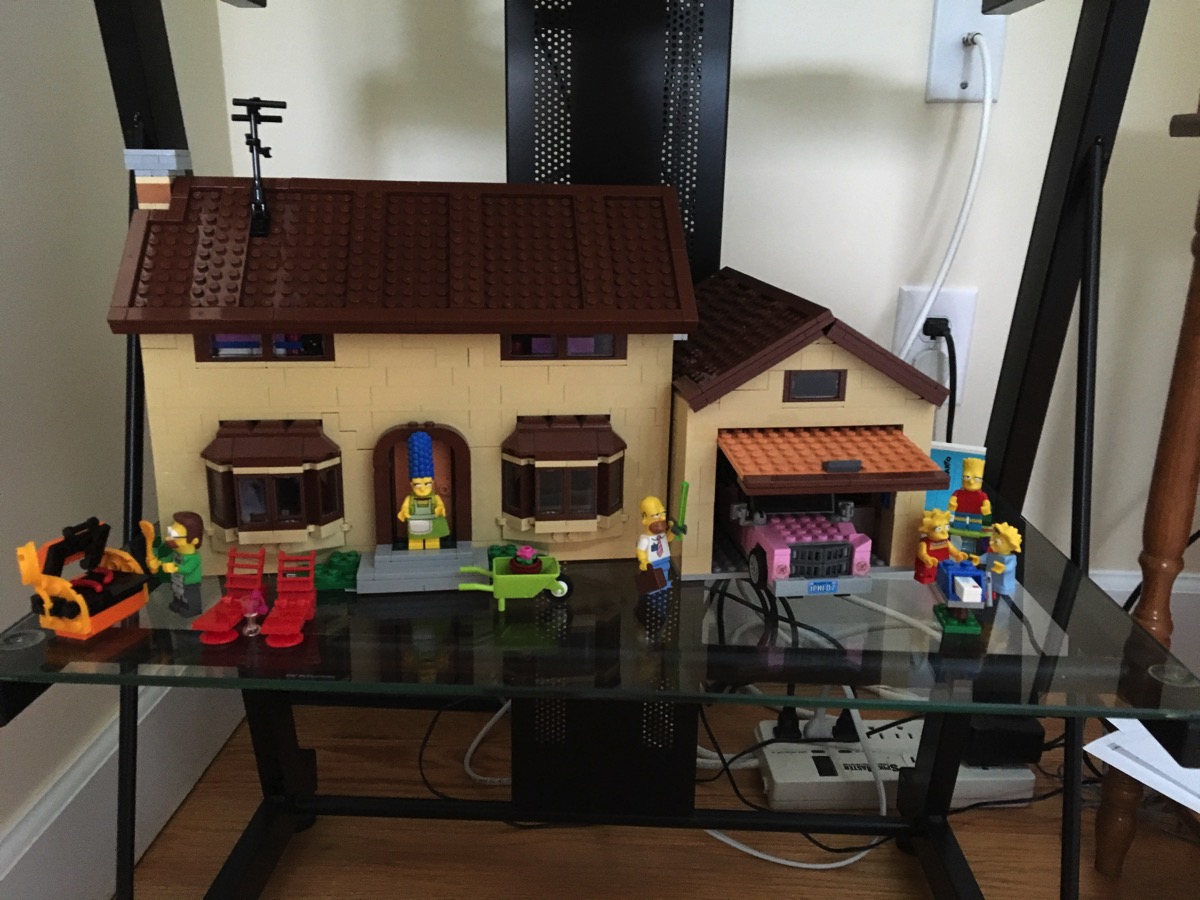
It took me about 2 years, a Patriots bye week, and some beer, but I finally put together the Lego set my wife got me for my birthday.

Not bad.
Tech, music, sports, and other stuff.
It took me about 2 years, a Patriots bye week, and some beer, but I finally put together the Lego set my wife got me for my birthday.

Not bad.
Like all things that become the standard, agile[1]/scrum is seeing a bit of a backlash. I just happened across a couple of interesting posts that lay out interesting arguments against the new standards.
First, a long article from OK I Give Up:
This is actually my biggest gripe about Scrum. As mentioned above, in Scrum, the gods of story points per sprint reign supreme. For anything that doesn’t bring in points, you need to get the permission of the product owner or scrum master or someone who has a say over them. Refactoring, reading code, researching a topic in detail are all seen as “not working on actual story points, which is what you are paid to do”. Specialization is frowned upon. Whatever technology you develop or introduce, you are not allowed to become an expert at it, because it is finishing a story that brings the points, not getting the gist of a technology or mastering an idea. These are all manifestations of the control mania of Scrum.
I do think there is something nefarious to the godliness of points in the Scrum process (and the immediate, inarguable counter-argument that if it isn’t working for you, you’re doing it wrong).
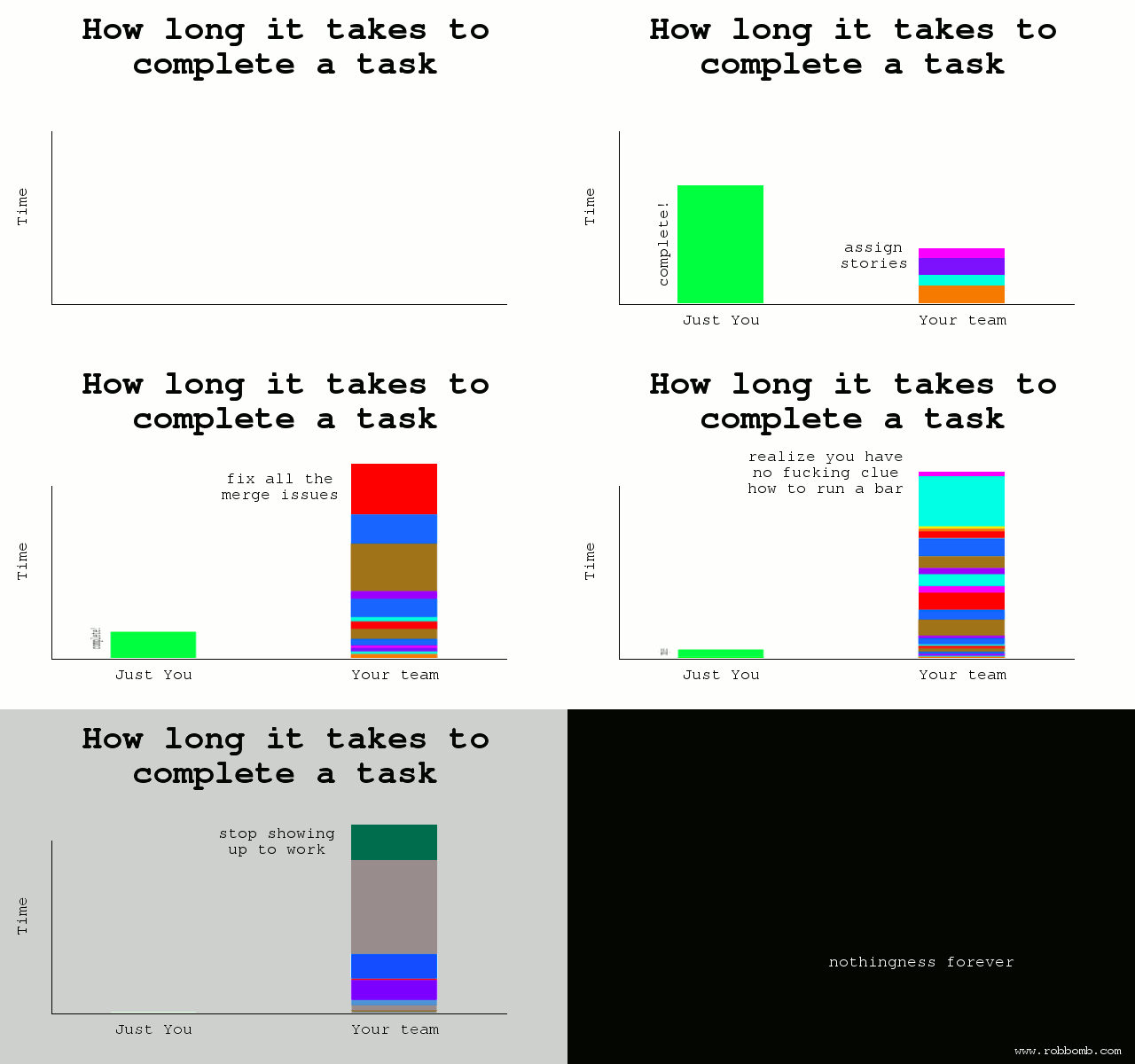
Put in a slightly more graphical way:

(Hilarious image from RobBomb)
During an election when one of the most divisive issues is how to help groups that have been left behind by a globalized/information economy, privilege is a topic that comes up frequently. It’s a challenging situation, where (in my slightly naïve view) a group of predominantly white, rural and suburban, lower-middle class people are feeling a lack of support from the government in protecting their traditional jobs and roles in the economy. Whether or not protecting their jobs is the right approach (or whether we should be investing in training/re-training) is up for debate.
What’s I don’t think is up for debate is that this has lead to an uncomfortable schism between that group and other groups who have also been held back in the economy for various reasons (gender, race, economic status, etc). Ironically, as this weekend’s SNL showed, those groups actually have more in common than not.
But things seem to get caught up on the concept of privilege and whether or not certain groups should be getting an “advantage”.
This is a long prelude to what I think is a really great way to describe privilege, from an article by Toria Gibbs and Ian Malpass:
Privilege does not mean you had it easy. It means you had it easier. If a man grows up in poverty, and drags himself out of it, that’s impressive. That’s hard. If he’d been a woman, he’d have had to do all the same things, while also fighting society’s expectations of what women can or should do. Privilege is what you don’t have to deal with.
There was a lot of noise about Apple Music competing with Spotify in iOS 10 with the algorithmically generated New Music playlist. I’ve been doing more driving than usual lately and got a chance to check out the New Music playlists. There’s been some gems, but there’s a lot of stuff I don’t like. That’s alright though—you want to have your boundaries pushed.
The Favorites Mix playlists, however, have been amazing. And that really makes sense. I’ve been putting music into iTunes since 2002, and I’ve been a stickler about rating songs over the years. When Apple Music came out, I took everything I’d rated 4 or 5 stars and “loved” it.
Apple has my ratings, songs I’ve loved, everything I’ve bought from the iTunes Store, and (if they pass this data to the cloud) my play counts and last played data. That’s almost 15 years of data, probably somewhere north of 100,000 played songs (last.fm has me at about 64k plays, but that doesn’t cover everything).
So, yeah, Apple should be able to make good playlists of my favorites. They’ve done a pretty good job. There’s some exceptions (interstitial tracks from albums I like), but they’ve been unearthing songs I may not have listened to in years. When I’m not sure what to listen to, the Favorites Mix has been a go-to, and it hasn’t really missed yet.
I just need to make sure I leave room for the New Music mixes …
They always warn you about upgrading to the first release. “Let them fix the bugs in the .1 before you upgrade,” they say.
I never listen.
In Sierra, I’ve run into an interesting problem where the first time I mount my Time Machine USB backup drive post-launch, it mounts and works just fine. I can then tell the OS to eject the disk, which it seems to. Except, in Disk Utility, it still thinks it’s there. And now this phantom disk prevents it from ever being mounted again, until I reboot.
I’ve tried command line mojo (diskutil and hdiutil), and both will say they’ve unmounted the drive, but it still shows up. Eventually, diskutil stops responding.
Reading online, there’s lots of folks reporting similar issues, but no one seems to have found a particularly good solution, other than “reboot.”
We’ll see if it gets fixed up in the .1 release. Until then, off to reboot.
Sometimes you feel like the forgotten man ...

Last year, I got reinvested in running. I’ve always been an ok runner, but never particularly great. I’d go out and run 2–3 miles at a decent pace, consider it a good workout, and be done. Then it’d get cold out, or rainy, and I’d go a few weeks (or months) without really running, and I’d lose a lot of my progress.
But, last year, as I mentioned, I got reinvested. I asked for cold weather running clothes, I bought new running shoes, and really started working with the Runkeeper app on my phone. I was trying to run at least 4–5 days a week, and then working up to a decent 4–5 mile run on the weekends. I felt pretty good about things, but I wasn’t really getting in better shape or improving my endurance or times.
Then I got sick. I traveled abroad, came back, traveled some more, and then traveled some more. I was sick for almost two months. After a couple doctor’s visits, I had finally kicked the lingering cold. It was time to get back out running.
I could barely run a mile; a slow mile.
I assumed something was wrong with me, so I went back to the doctor and had them check me out. They didn’t find anything.
Over the course of a couple of months, I’d regressed back to basically square one.
I remembered reading about Matt Cutt’s 30 day challenges where you do something every day for 30 days. Could I run every day for 30 days? A friend of mine had gone running every day for years, so I knew it was possible.
I started out slow—moderately paced 1–2 miles runs. I built up to faster paced runs. Then I built up to 3–4 miles. And that’s where I left it, because that felt comfortable.
My wife (who’s run multiple marathons) put it all in perspective one day: “Why do you stop at 4 miles? Why don’t you stop when you’re done? Why don’t you finish?”
It sounds stupid, but it really was a perspective shift for me. The next day, I did 6 miles. I took my 4 mile route and just kept going until my legs hurt.
I started aiming for longer runs on weekends. I signed up for a half marathon.
Towards the end of my 30 days, I aimed for a 10 mile run. It sucked, but I finished it. Since I’d been running every day, my pace for longer runs was close to my pace for shorter runs. For the first time ever, I was able to keep pace with my wife on a long run.
Why am I sharing this? Honestly, it’s to keep myself motivated to keep running. And, if anyone comes across it, maybe they won’t feel so daunted about getting started running.
There were a handful days I didn’t run more than .25 miles. Those were days when I didn’t run in the morning, got home, and just needed to get out to keep the streak going. I threw on my shoes and ran around the block. I think I averaged about 2.5 miles/day over the month.
The key: just get going. Don’t push yourself too hard[1]. Just try to run a little one week, then run a little more the next week. Mix up city running with country running. Do whatever you need to just check off that day.
If you were used to storing your ssh keys in your Keychain, you may have noticed that your ssh agent forwarding wasn’t working when you updated to macOS Sierra.
According to jirsbek on GitHub:
ssh-add -K in macOS Sierra no longer saves SSH keys in OS’s keychain. As Apple Developer stated: “That’s expected. We re-aligned our behavior with the mainstream OpenSSH in this area.”
I’m actually ok with the change in behavior. To resolve it, call ssh-add -A to add your identities into your ssh-agent. I’m doing that as part of my .bashrc (though I haven’t rebooted yet, I assume it’ll work).
(Via jirsbek on GitHub.)
Sean Nelson, talking about Built to Spill’s There’s Nothing Wrong With Love:
“The shadow Nevermind of post-boom NW indie rock was unquestionably Built to Spill’s There’s Nothing Wrong With Love, which came out September 13, 1994—not so very long after a certain tragic event—and soon became the North Star to a great many bands that came along after. The songs were exuberant and melodic, but they were also, somehow, intensely private. Even the artwork—a white and gray cloud floating over a muted palette of cream and yellow—was a masterpiece of understatement. You might not even see it the first time, but when you caught it at just the right moment, just the right angle, you could recognize the solitary statement that you had been let in on, and you treasured it all the more.”
I discovered this album in college, my gateway the 1998 B-sides album Naked Baby Photos by Ben Folds Five, which had a cover of "Twin Falls, leading me to buy a copy of TNWWL at the Record Exchange in Blacksburg.
And then I was that guy coming back and putting Built to Spill songs on mixtapes (and CDs, because I was ahead of the times) for everyone.
Sean Nelson also, humbly, left at least one album by his own band off his list.
(Via Pitchfork.)
Two articles I’ve come across recently that are worth reading:
I Spent 5 Years With Some Of Trump’s Biggest Fans. Here’s What They Won’t Tell You. (Mother Jones)
But something else seemed at play. Many blue-collar white men now face the same grim economic fate long endured by blacks. With jobs lost to automation or offshored to China, they have less security, lower wages, reduced benefits, more erratic work, and fewer jobs with full-time hours than before. Having been recruited to cheer on the contraction of government benefits and services—a trend that is particularly pronounced in Louisiana—many are unable to make ends meet without them.
This is one of those counter intuitive issues that neither political party seems ready to solve. How do you convince workers, whose jobs are evaporating due to technology (whether that’s technology replacing a worker, or technology lowering the barriers for others to do that job less expensively), to rely on the government for job training and benefits while transitioning into a new career?
Neither party wants to solve that (and certainly not during an election cycle).
How Fox News women took down the most powerful, and predatory, man in media. (NY Mag)
Her first assignment was to go down to the newsstand and fetch him the latest issue of Maxim. When she returned with the magazine, Ailes asked her to stay with him in his office. He flipped through the pages. The woman told the Washington Post that Ailes said, “You look like the women in here. You have great legs. If you sleep with me, you could be a model or a newscaster.” She cut short her internship. (Laterza did not respond to a request for comment.)
This was not even close to the worst offense. Jesus.